
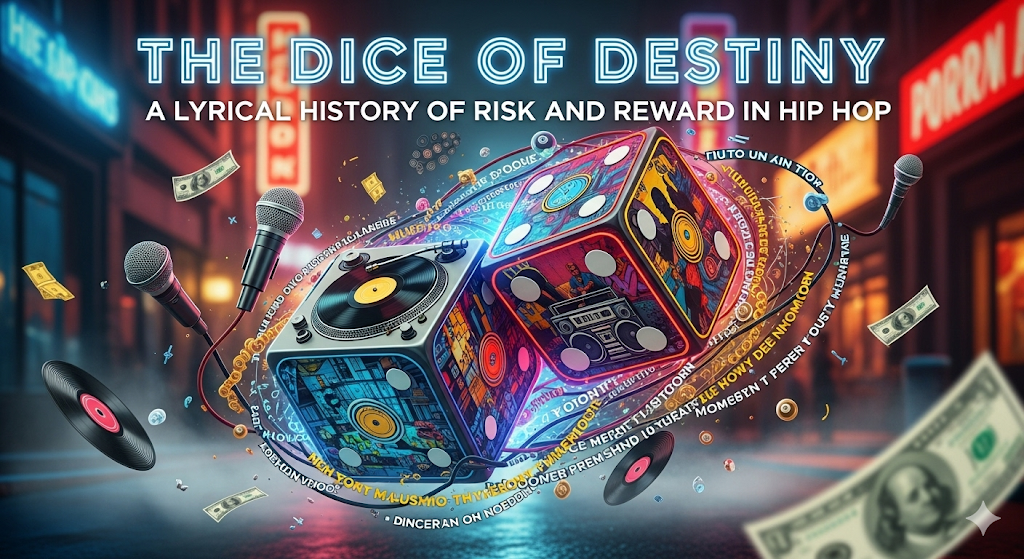
The worlds of hip hop and high-stakes gambling are closely related, and surprisingly, they share the same philosophy of taking risks, ambition, and seeking destiny. Nothing is certain in either arena; it is a high-stakes game where the combination of raw ability, calculated tactics, and a stroke of pure luck determines the outcome. It is this mutual belief that a record or a risky move can transform things, which has established an enduring and strong bond that has become part of hip hop lyrical DNA. This paper presents the development of the image of gambling from a basic and literal story to a complex and multi-tiered metaphor, which represents the evolution of the genre. We’ll trace this evolution from its earliest appearances as a casual backdrop to its more complex uses as a symbol for life’s biggest gambles, revealing a fascinating chronicle of an art form that uses its core metaphors to mirror its own reality.
The Early Stakes: A Slice of Life in the ’90s
Hip hop of the early ’90s was about reality. Artists such as Ice Cube and Scarface took their lyrics to create detailed portraits of real life, and gambling mentions were usually simply another line in these true-to-life stories. The dice were not a great analogy of a career; it was an element of the day-to-day struggle and a source of both frustration and triumph.
The best example of this early strategy is Ice Cube, 1993 classic, It Was a Good Day. The song is an account of a rare, perfect day, and a spell of fortune at the craps table is a highlight. He raps of a succession of ideal turns-“Wit tha seven, seven-eleven, seven-eleven”-a stroke of pure luck that adds to the success of the day as a whole. To Ice Cube, the win in the craps is to be celebrated, but the significance of the win lies within the events of the day. It is not about fate, but about appreciating a nice, positive moment.
On the same note, Let Me Roll by Scarface of the same year describes gambling as a mere leisure activity. He writes about an afternoon with friends, in which playing craps is a social pursuit and not a big-stakes one. Even in one of the most significant lines, he talked about losing money, but it did not matter since it was a fun pastime. This shows a casual, communal association with the activity, where winning or losing is not of much importance to the social experience. These early gambling imagery applications were rooted in realism, which emphasized the roots of hip hop, which are based on lived and true experiences.
The Metaphor Expands: Life as a High-Stakes Game
As hip hop matured, references to gambling started to shift from mere narrative to a direct and explicit metaphor for life’s unpredictable nature. The dice no longer served as a mere prop; they evolved into a symbol of the immense risks and unpredictability of the streets.
This change is epitomised by Sporty Thievz’s 1998 track, “Street Cinema.” The group likens a high-risk criminal act to “rolling a pair of dice,” communicating the message that the outcome was “always a gamble” with an uncertain outcome. The dice become a metaphor for the high-stakes decisions of street living, in which every decision carries the risk of life or death.
Nelly’s Nellyville (2002) carries this metaphor to another, philosophical plane. In his perfect world, there’s no lottery because “the dice gon’ do what the dice gon’ do.” This phrase is used to change the subject of luck to pure chance and implies that everything happens as a result of destiny only. By linking the dice to more general ideas of fate and systemic conflict, Nelly deploys the metaphor as a way of speaking about a dicey existence.
By the mid-2000s, the gambling metaphor had been extended to include interpersonal relationships. In Pitbull’s 2007 song “Go Girl,” the line “shake dem dice and roll ’em” not only refers to a woman’s dance moves, but also to the “gambling nature of relationships” and the risk of starting a new one. This application demonstrates how the dice analogy continues to evolve from financial or life-and-death situations into the more universal yet still high-stakes environment of human connection.
The Ultimate Bet: Betting It All on Yourself
The emergence of the “mogul era” of hip hop provided a new meaning to the gambling metaphor: the ultimate gamble on oneself. Gambling became a philosophy of life, a blueprint for success, and an icon of unwavering self-belief.
A quintessential figure of this era, Jay-Z makes repeated use of the metaphor of gambling to express his affective journey “from hustler to billionaire.” The name of his song “All In” captures this idea perfectly — the ultimate risk of self-belief. He characterizes his career as one momentous gamble in which he risked his whole life and future. Jay-Z’s gamble was an imperative, and he sees his personal success as a win for the culture he represents.
Similarly, the message of Nipsey Hussle’s “Dice Game” echoes his philosophy that success is never a given but achievable through “taking the right risks.” For Hussle, the gamble wasn’t only on himself but on his community. The “bragging right” wasn’t personal wealth, but building businesses and creating opportunities for the next generation. The battle between Jay-Z and Nipsey Hussle provides two different but equally impactful interpretations of the “ultimate bet.” For Jay-Z, it’s the story of personal dominance; for Nipsey, it’s the story of collective empowerment. The same metaphor, running the gauntlet of different life experiences, is philosophically radicalized.
High-Stakes Strategy: The Poker Face
As the lyrical stories grew more complicated, so did the gambling metaphors. The poker motif became a dominant sub-theme, with its emphasis on skill, strategy, and psychological warfare displacing a pure chance element. This attitude is a sign of a mature acceptance of the fact that the music business is a zero-sum competition where risk-taking and discipline are key.
Ghostface Killah’s “Pokerface” is an excellent example of this trope. The song is filled with specific poker lingo, like “know when to fold ’em,” and uses it as a context for living life and doing business in the music industry. The lyrics equate the ability to keep a poker face–to be calm and expressionless–with the need to be strategic in a competitive, high-stakes setting. This outlook represents a shift in the hip hop narrative from an external, contingent, or chance mindset to an internal, strategic mentality.
Kendrick Lamar’s “Vegas”: This track examines the casino metaphor for the high stakes and risks involved in love and vulnerability. The poker theme is used by him to metaphorize a shift away from a game of chance to a game of wits. There is also a romantic gamble and a financial one, as indicated by the lyrics: “Doin’ blackjack, twenty-one, twenty thousand in it.” He even uses dice to explain his willingness to “rollin’ dice with Lucifer to make sure I ain’t losin’ you,” suggesting the massive spiritual gravity of the emotional gamble. This metaphor enables artists to discuss topics of authenticity and the vulnerability that comes with risking one’s life “on the table” in the name of a prize.
The Duality of Fortune: The Cost of a Bad Bet
While the subject of gambling in hip hop is often described in a celebratory manner, there is another, less celebrated, yet equally important counter-narrative-the recognition of the loss and the realities of risk. This serves to add a necessary layer of depth, placing the theme on a higher level than mere braggadocio.
In his track “Countin’,” 2 Chainz provides a sobering counter-narrative to celebratory stories. He specifically describes the monetary loss that occurs from making a bad bet and rapping about “losing a hundred thousand dollars on a bet.” This unusual look into the dark side of the high-stakes lifestyle infuses the gambling trope with crucial layers of depth, reminding readers that the road to success is littered with both victories and expensive losses.
The Notorious B.I.G.’s posthumous classic, Mo Money Mo Problems, offers a great example of the double-edged myth of fortune. Despite it being the classic party song, there’s a cautionary message in the title and the central theme. The lyric “We don’t play around, it’s a bet, lay it down” evokes a constant high-stakes game where new challenges and problems are presented with growing wealth. This story shows that success is never an endpoint but an ongoing gamble, a gamble with the prize being fame and money, and the stakes being the repercussions that accompany it. This sophisticated take elevates the gambling metaphor to a more mature and realistic commentary on the unstoppable pressures of high-profile life.